
Spunlace nonwoven fabric for wipes and industrial use
Spunlace is made by entangling a fibre web with high pressure water jets. It gives a soft, drapeable, absorbent fabric with low lint, which is why wipes converters start here.
At a glance
Specification at a glance
| Parameter | Range offered for quotation | Confirm at enquiry |
|---|---|---|
| Fibre composition | Polyester, viscose, wood pulp, bamboo, ES blends | Blend ratio for your grade |
| Basis weight | 30 to 90 gsm working range | Tolerance for the target weight |
| Web structure | Parallel laid and cross laid | MD/CD ratio you need |
| Width | Slit to working width | Slit plan and core size |
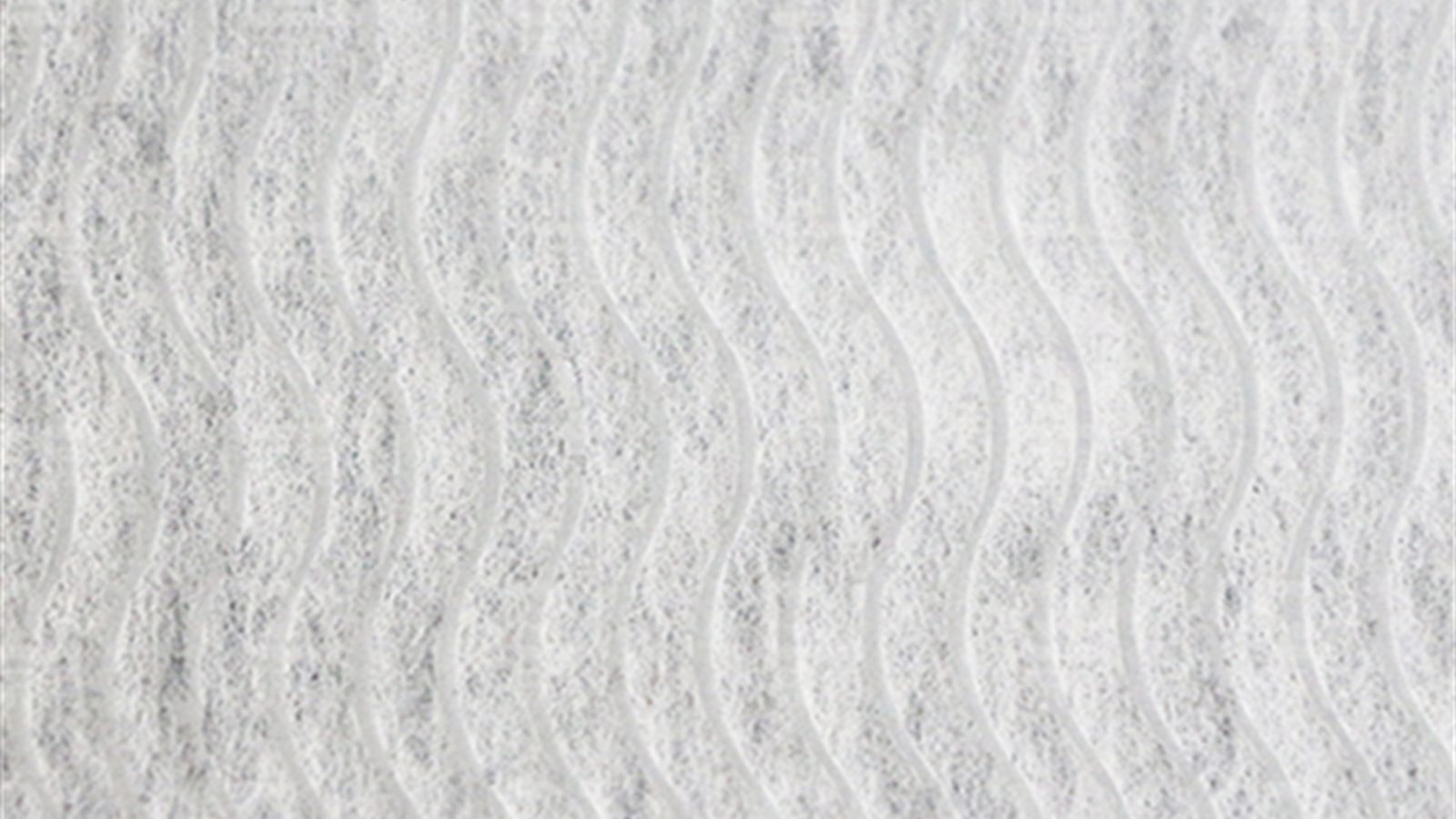
| Surface | Plain, dot, mesh and embossed patterns | Pattern availability per weight |
| Roll | Diameter and length to order | Splice limit per roll |
Why the fibre blend decides everything else
Viscose brings absorbency and softness. Polyester brings wet strength and dimensional stability. Wood pulp raises absorbency and lowers cost but changes lint behaviour and wet strength. Bamboo is chosen for hand feel and a marketing story, not for a performance advantage over viscose in most wipes.
The blend ratio is the first thing to fix, because gsm, pattern and bonding all behave differently once it changes. A 50/50 PET/viscose grade does not simply become a cheaper 30/70 grade.
Parallel laid versus cross laid
Parallel laid webs give a higher machine direction strength and a cleaner surface, which suits wipes that are cut and folded along the machine direction. Cross laid webs trade some MD strength for a better balance across both directions, which helps when the converting line pulls the web in different orientations or the finished product must resist tearing in both directions.
Which one you need is a question about your line, not about our preference. Send the machine data and the test that decides acceptance.
The properties that decide acceptance
Absorbency, lint level, wet strength, softness, pattern depth and running behaviour on the converter. A data sheet can describe the first five. Only a trial on your machine settles the sixth.
That is why most spunlace projects go through a trial roll before a bulk order, and why we ask for the unwind and folding conditions in the first enquiry.
Applications and fitting the grade to them
Wet wipes and dry wipes take the bulk of our spunlace output, followed by personal care, cosmetic pads and industrial wiping where low lint matters. Each of those has a different failure mode, and the page for each application explains what to specify.
If your application is not on that list, describe the end product. Most spunlace enquiries are variations of the same five or six specifications.
Grades in this range
The weights below are the ones quoted most often. Each has its own test values and its own failure modes, so the grade is chosen against the converting line and the end use, not against the price per tonne.
- 35 gsm spunlace - At 35 gsm a spunlace web is thin enough to see light through and still strong enough to su.
- 45 gsm spunlace - 45 gsm is the middle of the wet wipe range: heavy enough to hold a 300 percent lotion load.
- 50 gsm spunlace - 50 gsm is where a wipe stops being a baby product and starts being a tool: adult wipes, su.
- 60 gsm spunlace - 60 gsm is where spunlace stops being a consumer wipe and becomes a working cloth: solvent .
- 70 gsm spunlace - 70 gsm is the top of the standard wipe range. At this weight the web behaves more like a l.
- 80 gsm spunlace - 80 gsm is the top of the spunlace range we quote. The buyers are filtration, polishing and.
Send your wipes or wiping specification
Fibre blend, gsm, width and the property that decides acceptance are enough for a first answer.
Questions
Common questions
What gsm is standard for baby wipes?
Baby wipes normally use a weight in the 40 to 70 gsm band, with the exact number set by wipe size, lotion loading and the strength the converter needs. Ask for the range we can hold on the chosen blend.
Can the fibre blend be customised?
Yes, within what the lines can bond at the target weight. Send the ratio you want to try and the property it must deliver.
Is wood pulp spunlace available?
Wood pulp blends are quoted on request. The behaviour of a pulp blend differs from a viscose blend in lint, wet strength and converting, so a trial is normally advised.
Do you supply printed or coloured spunlace?
Colour and embossed patterns are available on selected grades. Printing is quoted after a technical check on the pattern and the ink.
Can I get a trial roll?
Yes. A trial roll at production width is quoted as a paid batch so it matches the bulk specification.