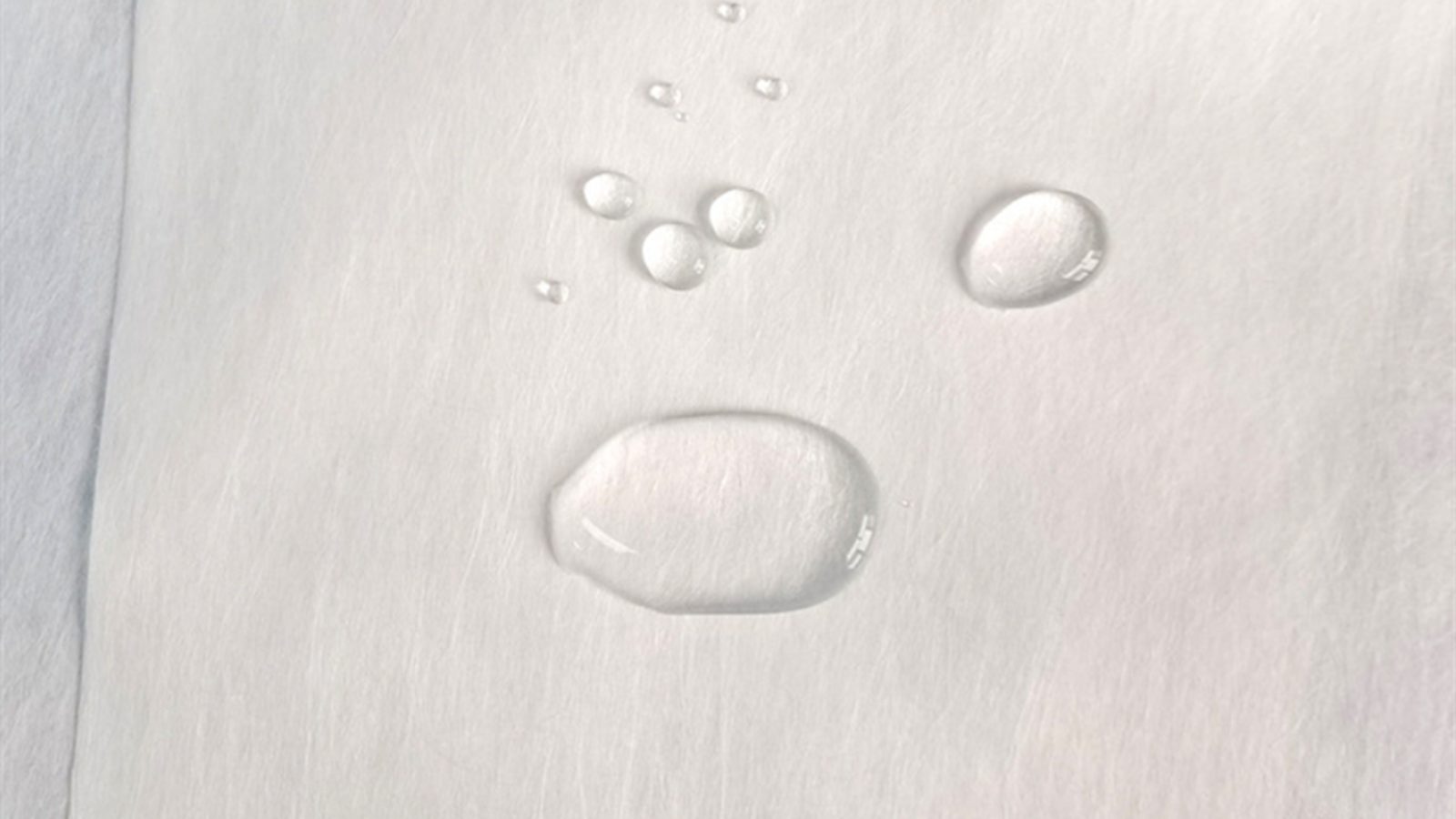
Finishing
Hydrophilic and hydrophobic finishing: what actually changes
The same base fabric can drink water or repel it, depending on a finish that may be a fraction of a percent of its weight. That finish decides whether a diaper wicks, whether a gown holds back fluid, and whether your lotion sits on the surface.
At a glance
Specification at a glance
| Finish | Effect | Typical use | Test that decides acceptance |
|---|---|---|---|
| Hydrophilic | Water spreads and wicks quickly | Diaper topsheet, wipes, absorbent cores | Strike through time, wicking rate |
| Hydrophobic | Water beads and runs off | Gowns, drapes, protective covers | Hydrostatic head, spray rating |
| Fluorine free repellent | Water and alcohol resistance without PFAS | Food and medical packaging | Repellency grade, alcohol repellency |
| Soft finish | Lower friction, softer hand | Baby care, facial products | Hand feel panel, coefficient of friction |
| Antistatic | Reduced static build up | Converting lines, filtration | Surface resistivity |
Hydrophilic is not one property
A fabric can be hydrophilic in the sense that water does not bead, and still be slow to wick. Strike through time and wicking rate measure different things: the first is how fast a drop disappears, the second is how fast fluid travels along the web. A topsheet needs both, a wipe needs absorption capacity more than speed.
Finish level, fibre type and bonding all change the result. The same finish on a spunbond and on a spunlace will not give the same number.
Hydrophobic, and the trend away from fluorine
Fluorochemical finishes give the best alcohol repellency, and they are being pushed out of medical and food supply chains by regulation. Fluorine free alternatives now reach useful water repellency but usually give up some alcohol resistance.
If your product claims alcohol repellency, say so at enquiry. It changes the finish, the test and the price, and it cannot be added after the fabric is wound.
Why finishes fail in the field
Most finish complaints are not chemistry failures. They are coverage failures: the finish did not reach the whole web, or it was damaged by a later heat step, or it migrated in storage. Corona and plasma treatments fade with time, so a treated roll has a shelf life for its effect, not just for its fabric.
Ask for the finish to be declared with the treatment method, and test after your own converting step, not before it.
How to specify a finish without overspecifying it
Name the test, the number and the point in the process where it is measured. A strike through time measured on the roll is not the same as on the finished product after a heat step, and a hydrostatic head measured on a flat sample is not the same at a seam. If the requirement is a finished product property, say so, because then the finish has to be validated downstream rather than at the winder.
The second thing to specify is durability: does the finish have to survive storage, converting, or a cleaning cycle. A finish that meets the number on day one and fades by month six is a specification that failed quietly.
Fluorine free, honestly
The market is moving away from fluorochemicals, and the replacements are good but not identical. Water repellency is now achievable at useful levels without fluorine; alcohol repellency is the harder claim, and some grades simply cannot make it. A buyer who needs both should ask early, because the answer changes the finish, the test method and the price, and it cannot be retrofitted after the roll is wound.
Tell us the application and the acceptance test
The reply names a grade we can run, the tolerance we can hold and a lead time, or says plainly that we cannot make it.
Questions
Common questions
Can you make an existing grade hydrophilic?
Usually yes, by applying a finish during production. It has to be planned into the run, so it is a production order rather than a stock item change.
How long does a hydrophilic finish last?
It depends on the chemistry and the storage. Most finishes hold for months in dry, cool storage; heat and humidity shorten it. If the finished product has a shelf life claim, the finish has to be tested against it.
Do you supply PFAS free repellent grades?
Yes, with the repellency level stated and tested rather than assumed. Where alcohol repellency is required, tell us at enquiry because the fluorine free options are narrower.