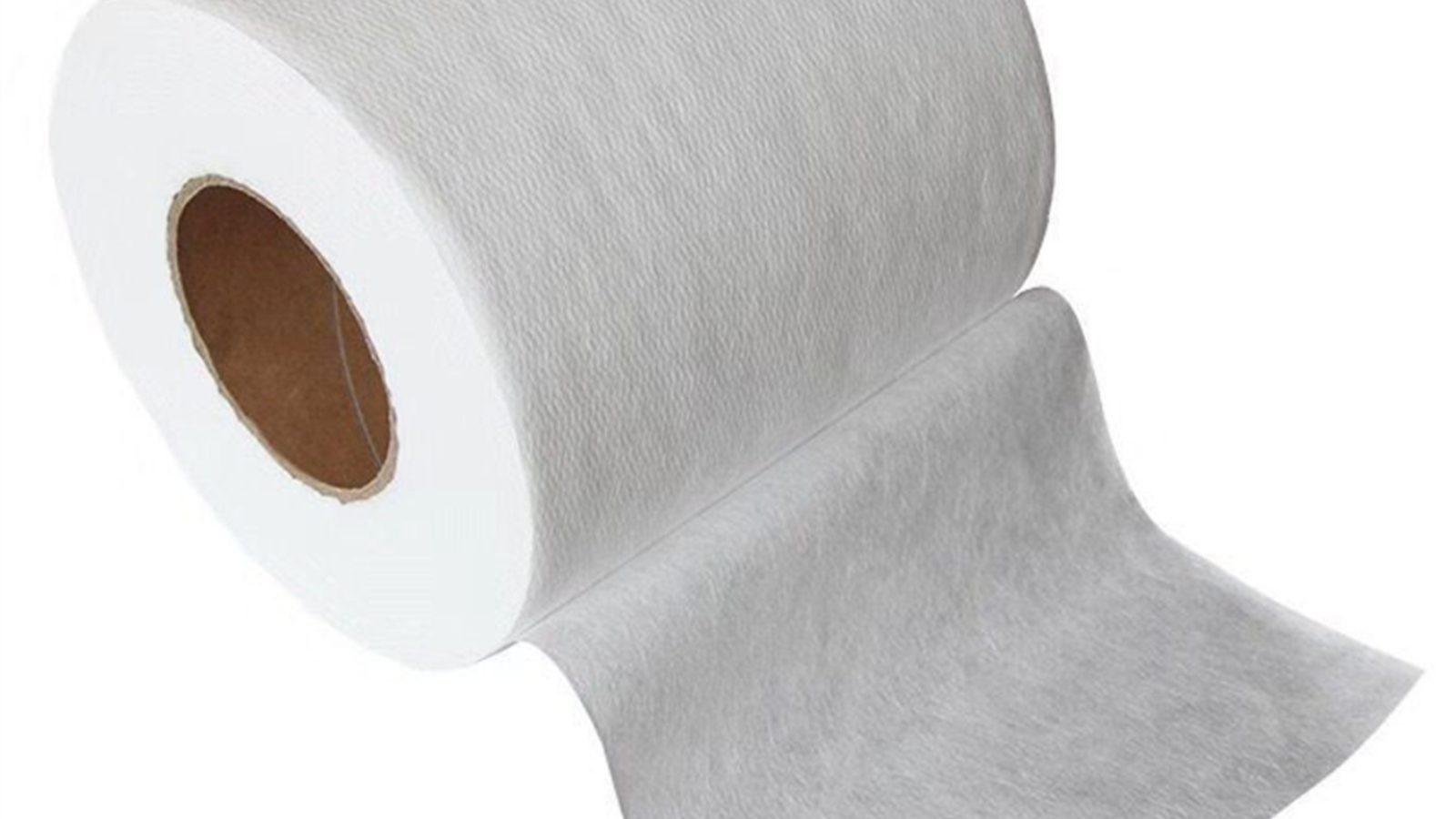
Heavy grades
60 gsm spunlace: the grade that survives a solvent
60 gsm is where spunlace stops being a consumer wipe and becomes a working cloth: solvent resistant enough for workshop hand wipes, strong enough for medical cleaning.
At a glance
Specification at a glance
| Property | 60 gsm typical range | Note |
|---|---|---|
| Weight tolerance | ±2 g/m² | Batch average |
| Tensile MD | 36 to 44 N/5 cm | Dry |
| Tensile CD | 15 to 19 N/5 cm | Wet retention 55 to 70 % |
| Lotion load | 250 to 300 % | Solvent systems run lower |
| Solvent resistance | Good in IPA and glycol ethers | Confirm with your formulation |
| Abrasion | Martindale 100+ cycles to hole | Grade dependent |
| Typical roll | 1,600 mm, 800 to 1,000 m | Core 76 mm |
Why industrial wipes jump from 50 to 60
Hand wipes meet two things a surface wipe does not: a rough substrate and a solvent. Solvent swells the web and reduces wet strength, and a rough substrate abrades it. At 60 gsm a 50/50 viscose polyester web keeps 55 to 70 percent of its dry strength when saturated, which is the margin that stops a wipe shredding in a mechanic's hand.
The trade is lotion load. At this weight the web holds less liquid per gram, so a 60 gsm industrial wipe typically carries 250 to 300 percent rather than 350.
Medical cleaning and disinfection
For hospital surface wipes, 60 gsm is common because the wipe has to survive a folded scrub and a quat load without leaving lint. Lint is a function of fibre length and bonding, not weight alone, but the heavier web tolerates a tighter hydroentanglement pattern that reduces loose fibre.
If the product carries a biocidal claim, the fabric does not decide registration; the formulation does. The fabric specification only has to prove it does not react with the active or shed into the application.
What to write in the purchase specification
Wet tensile in both directions, solvent compatibility list, lint level, and the abrasion test method with a cycle count. Without a cycle count the abrasion claim is an opinion, and the first complaint will be settled by whoever has a photograph.
Other weights in this range
This grade sits in the Spunlace range. Buyers comparing across weights usually ask for two or three of these at sample stage, because the decision is made on the converting line rather than on the data sheet.
- 35 gsm spunlace - At 35 gsm a spunlace web is thin enough to see light through and still strong .
- 45 gsm spunlace - 45 gsm is the middle of the wet wipe range: heavy enough to hold a 300 percent.
- 50 gsm spunlace - 50 gsm is where a wipe stops being a baby product and starts being a tool: adu.
- 70 gsm spunlace - 70 gsm is the top of the standard wipe range. At this weight the web behaves m.
- 80 gsm spunlace - 80 gsm is the top of the spunlace range we quote. The buyers are filtration, p.
Check this grade against your line
Send the application, the width you run and the monthly volume. We reply with the grade tolerance, the test values for that batch and a ship date.
Questions
Common questions
Does 60 gsm resist alcohol based cleaners?
It performs well in IPA and common glycol ethers. Test the actual formulation, because high solvent concentrations and long soak times change the result.
Is 60 gsm used for medical wipes?
Yes, for hospital surface and instrument wipes. Patient contact products are usually a different grade with a declared fibre and finish.
What width can it be supplied in?
Standard line widths up to 3,200 mm, slit to converter width. Send the target width and we confirm the slitting loss.