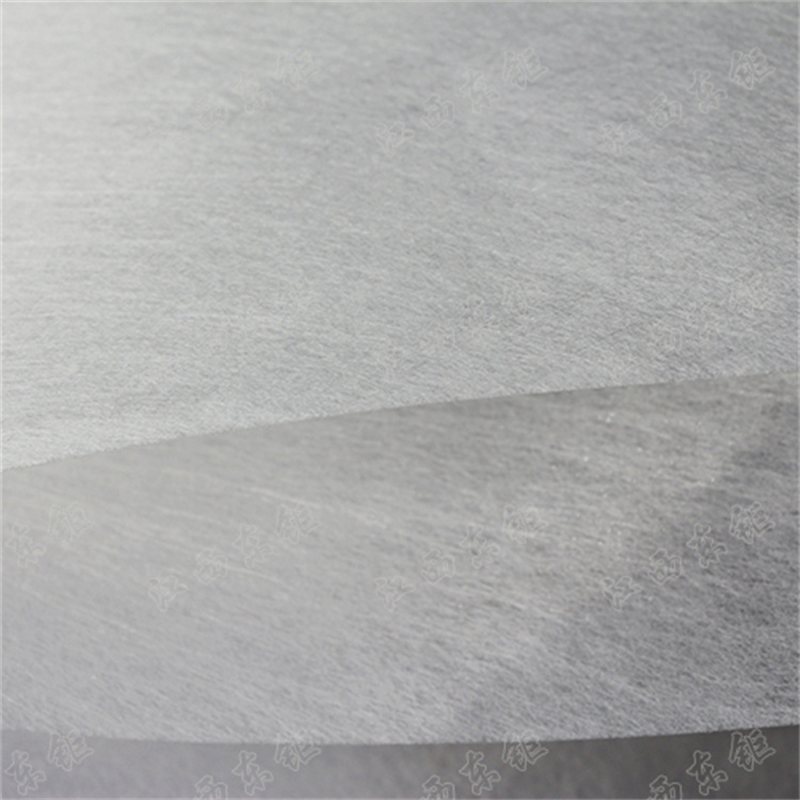
Soft grades
40 gsm ES hot rolled: softness without a finish
40 gsm ES is a PE sheath, PP core bicomponent web bonded by heat alone. No binder, no latex, and a hand feel that comes from the fibre rather than a softener.
At a glance
Specification at a glance
| Property | 40 gsm typical range | Note |
|---|---|---|
| Structure | PE sheath, PP core | Thermal bonded |
| Tensile MD | 15 to 22 N/5 cm | Softer than spunbond |
| Tensile CD | 8 to 12 N/5 cm | Low, by design |
| Elongation MD | 60 to 90 % | Conforms to shaping |
| Strike through | Fast, under 3 s | Suits top sheet |
| Binder | None | Thermal bonding only |
Softness that comes from the structure
Hot rolled ES skips the water jets and the binder, so the web keeps a loft that spunlace compacts and spunbond does not have. The PE sheath melts at a low temperature, bonding the web at points rather than throughout, which leaves the surface soft against skin.
Why top sheets use it
A top sheet has to pass liquid quickly and keep the surface dry. The 40 gsm web with a fast strike through and a low CD tensile is deliberately weak in one direction so it drapes with the product rather than fighting it.
Where it is the wrong choice
Anything needing high tensile, solvent resistance or a barrier. The low melting sheath also limits heat exposure downstream, so laminating temperatures have to stay below the sheath point.
Other weights in this range
This grade sits in the ES hot rolled range. Buyers comparing across weights usually ask for two or three of these at sample stage, because the decision is made on the converting line rather than on the data sheet.
- 60 gsm ES hot rolled - 60 gsm ES keeps the soft hand of the lighter grade and adds enough tensile to .
- 80 gsm ES hot rolled - 80 gsm ES is the heavy end of the soft range: padding, liners and medical soft.
Check the grade against your product
Send the application, the width and the monthly volume. We reply with the tolerance, the batch test values and a ship date.
Questions
Common questions
Is ES hot rolled the same as spunbond?
No. Spunbond is a single polymer extruded as filament. ES is bicomponent fibre bonded by melting the sheath, which gives a softer, loftier web.
Does it contain latex or binder?
No. Bonding is thermal. That is one reason it is chosen for skin contact products.
What temperature should converting stay below?
Below the sheath melting point, typically around 130 °C. Confirm with the grade data sheet before setting a laminating nip.