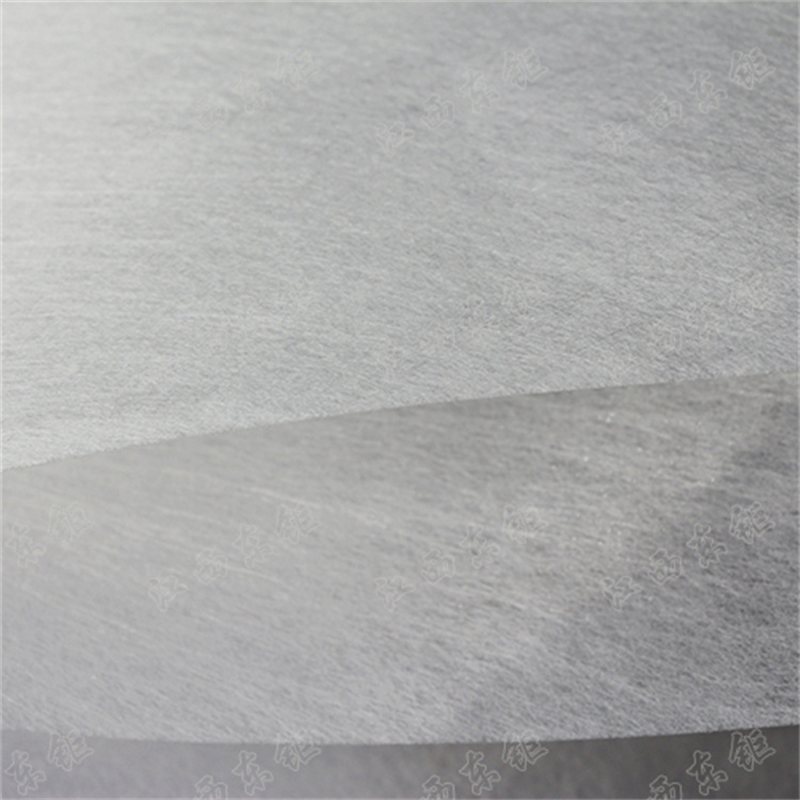
Structural grades
50 gsm bicomponent: stronger support layer
50 gsm bicomponent is a support and structural layer: filter media backing, automotive trim, laminating substrates.
At a glance
Specification at a glance
| Property | 50 gsm typical range | Note |
|---|---|---|
| Fibre | PET sheath, PET core option | Higher temperature |
| Tensile MD | 28 to 36 N/5 cm | Calender bonded |
| Tensile CD | 14 to 20 N/5 cm | Support strength |
| Temperature | Up to 150 °C with PET sheath | Grade dependent |
| Air permeability | Medium | Suits support layers |
| Stiffness | Higher than 30 gsm | Holds pleats |
Support layers that hold a pleat
A filter support has to keep its shape through pleating and through the temperature of the application. A PET sheath raises the service temperature and the stiffness, which is why automotive and industrial filters use this grade rather than the softer PE version.
Automotive trim
Trim substrates need dimensional stability and a surface that accepts adhesive. The 50 gsm bicomponent web takes both, and it does not off-gas the way a binder bonded felt can in a hot cabin.
Laminating notes
Because the web bonds at its own sheath temperature, it can be laminated to itself or to a nonwoven without added adhesive, which simplifies the process and the declaration.
Other weights in this range
This grade sits in the Bicomponent range. Buyers comparing across weights usually ask for two or three of these at sample stage, because the decision is made on the converting line rather than on the data sheet.
- 30 gsm bicomponent - 30 gsm bicomponent web bonds by melting the fibre sheath, so it holds together.
Check the grade against your product
Send the application, the width and the monthly volume. We reply with the tolerance, the batch test values and a ship date.
Questions
Common questions
Can it replace a needle punched felt?
In thin support and trim applications, yes. Where thickness and acoustic mass matter, a needle punched felt is still the right product.
What is the service temperature?
Around 150 °C with a PET sheath, lower with PE. Confirm the grade before specifying a hot application.
Is it food contact safe?
Depends on the polymer and additives. Ask for a declaration for the specific grade rather than the family.