Soft grades
30 gsm bicomponent: bonded without chemistry
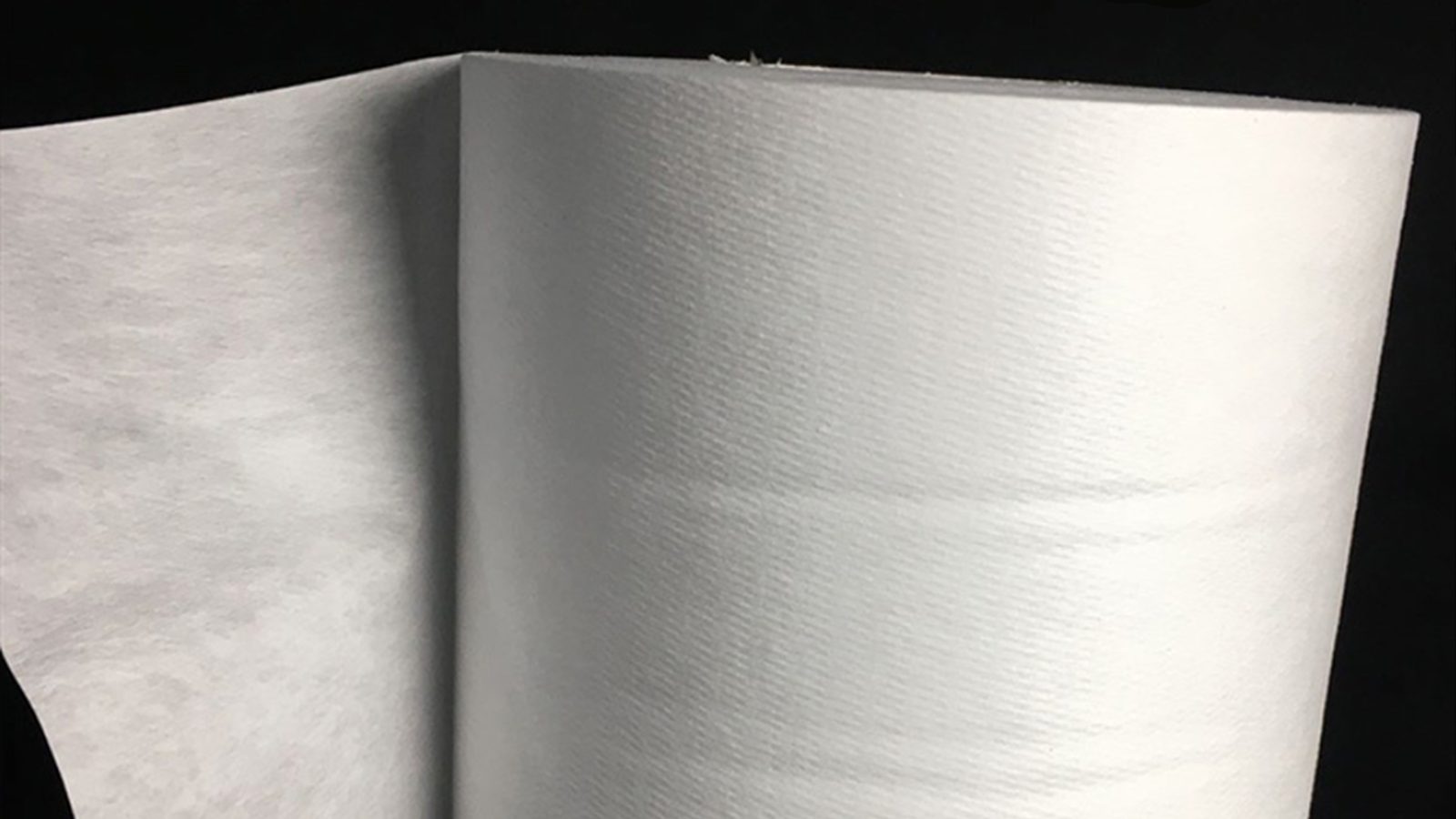
30 gsm bicomponent web bonds by melting the fibre sheath, so it holds together without latex, binder or water jets.
At a glance
Specification at a glance
| Property | 30 gsm typical range | Note |
|---|---|---|
| Fibre | PE or PET sheath, PP or PET core | Grade dependent |
| Tensile MD | 18 to 25 N/5 cm | Thermal bonded |
| Tensile CD | 9 to 14 N/5 cm | Lower by design |
| Softness | Soft, no binder | Suits skin contact |
| Air permeability | High | Open bonded structure |
| Bonding | Through air or calender | Two different hands |
Through air versus calender bonding
The same fibre gives two products. Through air bonding produces a lofty, soft web for absorbent hygiene; calender bonding produces a flat, stronger web for lamination and filtration support. The buyer has to say which hand is wanted before the grade is quoted.
Where 30 gsm fits
Top sheets, acquisition layers and light filter supports. It is light enough to be drapable and strong enough to run on a converting line without a carrier.
The chemical advantage
No binder means no formaldehyde question and no latex declaration, which shortens the compliance conversation for skin contact products.
Other weights in this range
This grade sits in the Bicomponent range. Buyers comparing across weights usually ask for two or three of these at sample stage, because the decision is made on the converting line rather than on the data sheet.
- 50 gsm bicomponent - 50 gsm bicomponent is a support and structural layer: filter media backing, au.
Check the grade against your product
Send the application, the width and the monthly volume. We reply with the tolerance, the batch test values and a ship date.
Questions
Common questions
What is the difference from ES hot rolled?
ES is a specific bicomponent type, PE sheath on PP core, bonded by hot rolling. Bicomponent is the broader family and includes PET sheath grades for higher temperature use.
Can it be used in filters?
As a support or pre-filter layer. Fine filtration needs meltblown.
Is it absorbent?
The web itself is not. Absorbency comes from adding pulp or a viscose blend.