
Material comparison
Spunlace vs spunbond: the differences that decide your order
Both are nonwoven. They are made by different processes, they fail in different ways, and choosing the wrong one is usually discovered on the converting line rather than in the specification meeting.
At a glance
Specification at a glance
| Property | Spunlace | Spunbond |
|---|---|---|
| Bonding | Water jet entanglement of staple fibres | Thermal bonding of continuous filaments |
| Hand feel | Soft, drapeable | Firmer, paper like at low weight |
| Strength per gram | Lower | Higher |
| Absorbency | High, tunable by blend | Low unless treated |
| Lint | Low when well bonded | Very low |
| Cost per kg | Higher | Lower |
| Typical use | Wipes, personal care, wiping | Hygiene, packaging, agriculture, furniture |
The short answer
If the product touches skin, absorbs liquid or must feel soft, start with spunlace. If the product must hold shape, resist tearing or cover an area cheaply, start with spunbond. If it must do both, you are looking at a composite, and the composite is its own specification.
That answer covers most enquiries. The rest of this page is about the cases where it is not enough.
How the two processes differ
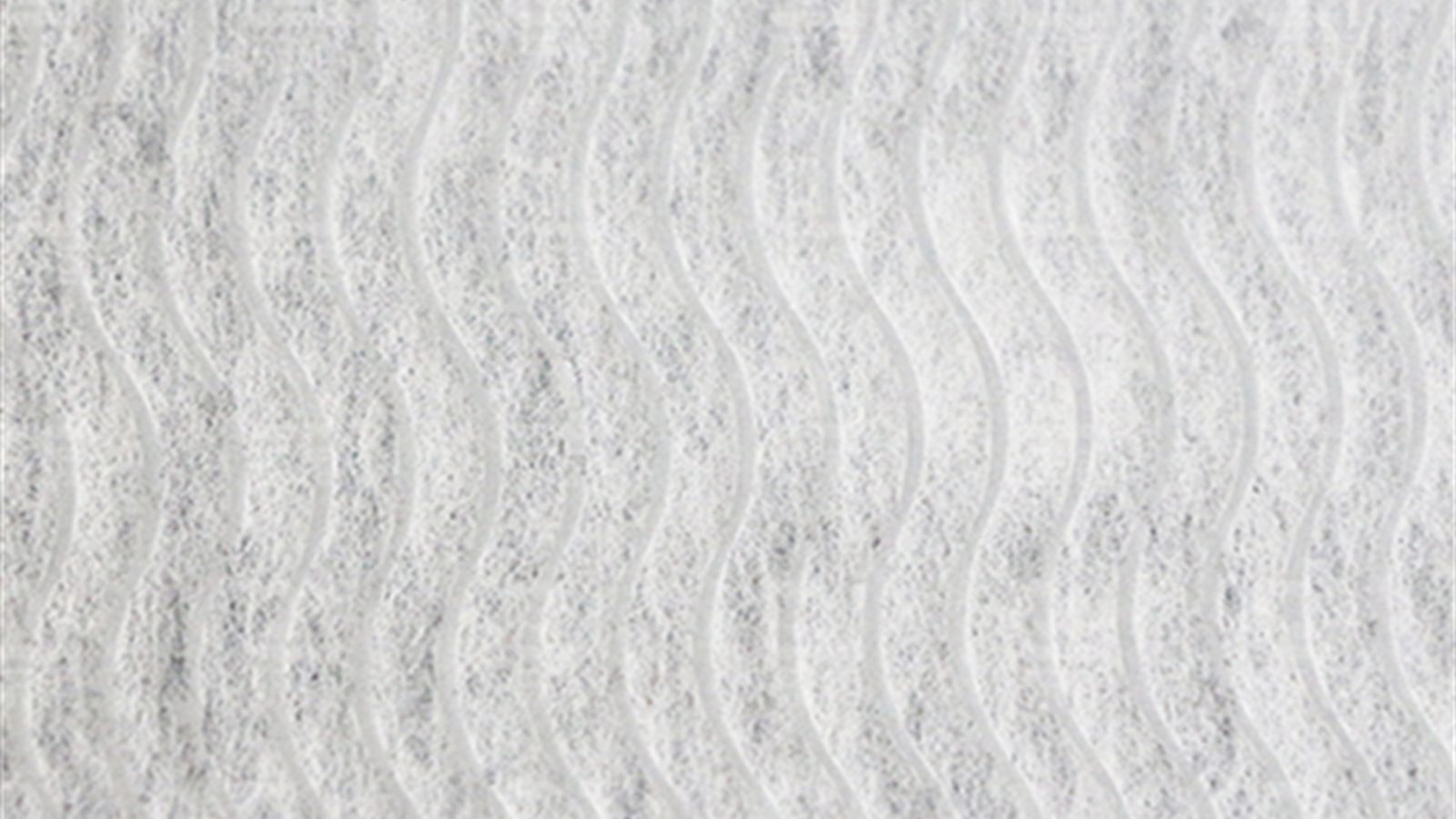
Spunlace begins with a carded web of staple fibres, usually a blend of polyester, viscose, pulp or similar. High pressure water jets entangle the fibres mechanically. Nothing is glued and nothing is melted, so the fabric keeps the softness of the fibre itself.
Spunbond begins with polymer granules. Filaments are extruded, laid into a web and bonded by heat and pressure at the calender. The result is a continuous filament structure, which is why it is strong for its weight and why it feels firmer.
The consequence for a buyer is simple: spunlace properties come mostly from the fibre blend, spunbond properties come mostly from the polymer and the bonding pattern. That changes what you negotiate.
Strength, elongation and what it means on the line
Spunbond wins on tensile strength at equal weight, often by a wide margin. On a high speed converting line that pulls, folds and cuts, that margin translates into fewer web breaks. If your line runs fast and the fabric path has sharp turns, spunbond or a spunbond composite is usually the safer choice.
Spunlace wins on elongation and drape. That matters when the product must conform to a shape, such as a wipe folded into a tight pack or a material used against skin. A stiff fabric that does not drape is a design problem no weight increase will fix.
Absorbency and the treatments buyers forget
Spunlace absorbs because the fibre absorbs and the structure holds liquid between fibres. Blend choice moves absorbency more than weight does. Viscose and pulp raise it, polyester lowers it but adds wet strength.
Spunbond is naturally hydrophobic. To make it absorb, the producer applies a hydrophilic finish, and that finish is a specification item, not a default. Ask which side is treated and what the strike through requirement is, because a finish applied on the wrong face produces a product that looks right and performs backwards.
Lint, extraction and cleanroom thinking
Neither process is lint free, but they fail differently. Spunlace can shed short fibres if the entanglement is weak or if the fabric is abraded. Spunbond sheds very little because the filaments are continuous, which is why it is preferred in applications where particle count matters.
If you need a low particle material for a controlled environment, specify the test: wet lint, dry lint, or particle count under a defined method. An adjective in a data sheet is not a measurement.
Cost per kilogram versus cost per part
Spunbond is usually cheaper per kilogram. That is not the same as cheaper per finished product. A lighter spunbond that breaks on the line costs more than a slightly heavier spunlace that runs clean, once stop time is counted.
Run the comparison on cost per thousand wipes or per square metre of finished product, not on the invoice price of a roll.
The composite case
SMS and SMMS exist because neither process alone delivers barrier plus strength plus softness. A composite adds cost and adds a failure mode at the bonding interface, so it should be chosen for a stated requirement, not as insurance.
If a buyer asks for SMS without being able to name the barrier test, the honest answer is that they may not need it. Ask what the finished product must pass before paying for a layer you cannot justify.
Choosing between the two for a new product?
Describe the product and the property that decides acceptance. We will tell you which process can meet it.
Questions
Common questions
Can spunlace replace spunbond in a hygiene product?
Sometimes in the topsheet, rarely in the backsheet. Barrier and strength requirements usually keep spunbond in the structure.
Which one is better for printing?
Both print, but the surface and the ink system decide quality. Spunbond holds a crisper edge at low weight; spunlace takes ink into the fibre.
Is spunlace always more expensive?
Per kilogram, usually. Per finished unit, not always, because weight and line performance change the arithmetic.
What about biodegradability?
It depends on the fibre or polymer, not on the process. A viscose spunlace and a PP spunbond are not comparable on that measure.